Descriptions omit how criteria are applied.
Events and gatherings / Survey guide
Events and gatherings · A focused questionnaire
Award judging process copy survey
Clarify judging process descriptions.
Opens product registration. Example questions are not imported automatically.
PLAN A BOUNDED FOLLOW-UP
Publish the verified judging overview.
After testing this change—Publish the verified judging overview.—ask people who encountered the changed arrangement whether this original issue still occurred or did not occur: “Descriptions omit how criteria are applied.” Invite a concrete explanation, including none or not applicable. Compare participant context and sample differences; a before-and-after survey alone does not establish causation.
Synthetic planning example. A repeat survey alone does not establish causation.
Read the answers carefully
What these answers cannot establish.
Not a judging fairness certification.
Descriptions omit how criteria are applied. This is an illustrative pattern, not observed customer data. Not a judging fairness certification.
A useful starting point
Three questions for this specific decision.
Clarify judging process descriptions. These prompts examine process scope, criterion clarity, disclosure need. Choose only questions your audience can answer. A missing detail can be answered with none; do not assume an issue occurred.
If nothing was unclear or difficult, say so. Skip questions about steps you did not experience; use not applicable where appropriate.
What process did the description explain?
Read for process scope. Keep the specific explanation in the respondent’s own words rather than converting it into an unexplained overall satisfaction score.
Which criterion definition was unclear?
Read for criterion clarity. Keep the specific explanation in the respondent’s own words rather than converting it into an unexplained overall satisfaction score.
What disclosure reference was missing?
Read for disclosure need. Keep the specific explanation in the respondent’s own words rather than converting it into an unexplained overall satisfaction score.
If nothing was unclear or difficult, say so. Skip questions about steps you did not experience; use not applicable where appropriate.

What process did the description explain?
Which criterion definition was unclear?
What disclosure reference was missing?
Download the questions as text ↓
Examples to adapt, rather than a validated research instrument.
Before you send it
Check what your wording assumes.
Would you agree that this entire experience was clear and easy?
What process did the description explain?
The first wording assumes a positive outcome and combines clarity with ease. The revised prompt asks about the concrete situation; respondents may report no difficulty.
A worked interpretation example
From a comment to a practical next step.
Illustrative scenario. These are not customer results.
Keep the finding specific
Descriptions omit how criteria are applied.
Choose an action to test
Publish the verified judging overview.
Check the experience again
After testing this change—Publish the verified judging overview.—ask people who encountered the changed arrangement whether this original issue still occurred or did not occur: “Descriptions omit how criteria are applied.” Invite a concrete explanation, including none or not applicable. Compare participant context and sample differences; a before-and-after survey alone does not establish causation.
From question to next step
Make the feedback useful.
Set the decision
Clarify judging process descriptions.
Invite relevant voices
Ask after an adult respondent has encountered this specific situation. For draft-copy testing, show the actual material first; accept none or not applicable when the issue did not occur.
Choose an action
Publish the verified judging overview.
Choose the response format
Make room for the explanation.
| Question | Suggested format | What to preserve |
|---|---|---|
| What process did the description explain? | Optional free text; none or not applicable accepted | Read for process scope. Keep the specific explanation in the respondent’s own words rather than converting it into an unexplained overall satisfaction score. |
| Which criterion definition was unclear? | Optional free text; none or not applicable accepted | Read for criterion clarity. Keep the specific explanation in the respondent’s own words rather than converting it into an unexplained overall satisfaction score. |
| What disclosure reference was missing? | Optional free text; none or not applicable accepted | Read for disclosure need. Keep the specific explanation in the respondent’s own words rather than converting it into an unexplained overall satisfaction score. |
Make questions optional where appropriate. If you add a rating scale, label its endpoints, keep one idea per question, and retain a follow-up for reasons. These examples are not a validated measurement instrument.
Before you send it
Questions, answered.
Who should answer?
Adult attendees, speakers, exhibitors or organizers who experienced the described event activity. Ask only about the step each person actually encountered; voluntary responses are not automatically representative.
What does the first question help explain?
Read for process scope. Keep the specific explanation in the respondent’s own words rather than converting it into an unexplained overall satisfaction score. It supports this decision: Clarify judging process descriptions.
What should I preserve in the second answer?
Read for criterion clarity. Keep the specific explanation in the respondent’s own words rather than converting it into an unexplained overall satisfaction score.
How should I read the third answer?
Read for disclosure need. Keep the specific explanation in the respondent’s own words rather than converting it into an unexplained overall satisfaction score. Not a judging fairness certification.
What would a practical follow-up look like?
Publish the verified judging overview. After testing this change—Publish the verified judging overview.—ask people who encountered the changed arrangement whether this original issue still occurred or did not occur: “Descriptions omit how criteria are applied.” Invite a concrete explanation, including none or not applicable. Compare participant context and sample differences; a before-and-after survey alone does not establish causation.
Can I load this automatically in SurveyTeams?
The page offers text, CSV, JSON and Markdown downloads plus manual copying. Registration does not import the questionnaire. Use account-supported features and verify your own response-handling arrangements.
Inside the product
Create a manual draft and check the questions
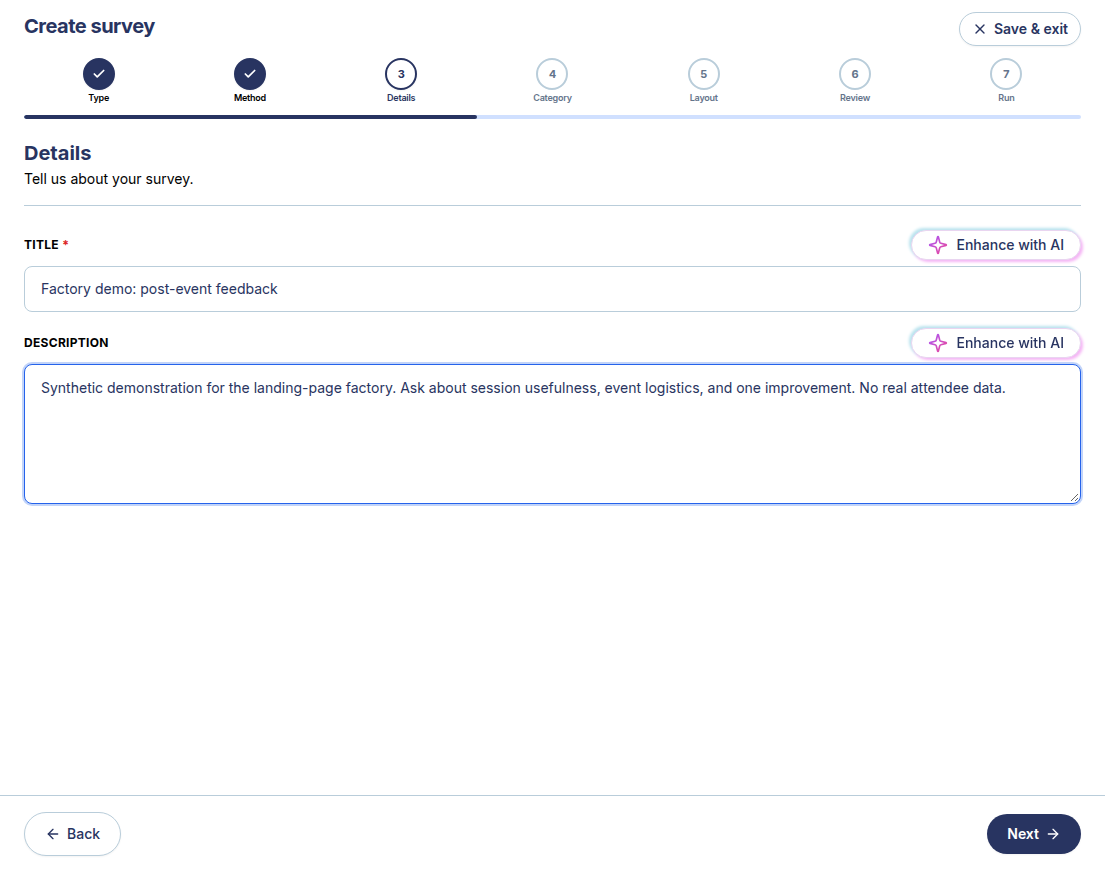
The real SurveyTeams screenshot shows a separate labelled synthetic event survey. It demonstrates the manual builder, not this questionnaire already loaded and not the task described in the software being evaluated.
- Start a draft with this decision in mind: Clarify judging process descriptions.
- Copy or select only applicable questions from this page. Add them as optional text prompts; the download is an editorial definition, not a product importer.
- Preview the respondent wording. Not a judging fairness certification. Explain your actual response handling before distribution.
Creation and preview were exercised in the observed account. Distribution, results and other features are separate workflows and depend on account conditions.
Build with SurveyTeams
Adapt these questions in your own survey.
Use these examples to draft your questionnaire. Create a survey draft, add questions, and check the respondent preview in SurveyTeams. Additional features depend on your account and plan.
Create your survey in SurveyTeams
Opens product registration. Example questions are not imported automatically.
Learn about the product ↗Continue exploring