How easy is it to get a decision when working remotely?
Identify how a remote colleague obtains a decision; compare waiting for approval with difficulty finding the decision-maker.
People at work · Practical field guide
Understand how location, communication, and work boundaries affect the team.
Opens product registration. Example questions are not imported automatically.
ILLUSTRATIVE FINDING → ACTION
Example answers describe missed decisions rather than a lack of meetings.
Publish a short decision log with owners and dates before adding another recurring call.
Synthetic scenario, not a customer result.
Read the answers carefully
Do not infer productivity from home conditions or require personal household details.
Example answers describe missed decisions rather than a lack of meetings. This is an illustrative interpretation problem rather than a real customer result. Publish a short decision log with owners and dates before adding another recurring call.
A useful starting point
Understand how location, communication, and work boundaries affect the team. Choose the questions that fit the experience you are investigating; avoid asking people to evaluate a step they did not encounter.
If nothing was unclear or difficult, say so. Skip questions about steps you did not experience; use not applicable where appropriate.
Identify how a remote colleague obtains a decision; compare waiting for approval with difficulty finding the decision-maker.
Name a recurring meeting and the information it supplies before assuming an asynchronous update could replace it.
Distinguish time-zone overlap, notification expectations, and unfinished work when investigating difficulty ending the day.
Find decisions people need to revisit so the team can choose a durable place for the final explanation.
Identify exceptions where discussion resolves uncertainty faster; do not treat every live conversation as avoidable.
If nothing was unclear or difficult, say so. Skip questions about steps you did not experience; use not applicable where appropriate.

How easy is it to get a decision when working remotely?
Which recurring meeting could be replaced by an update?
What makes it difficult to disconnect at the end of your workday?
Which decision would benefit from a written record?
When is a live conversation more useful than an asynchronous update?
Download the questions as text ↓
Examples to adapt, rather than a validated research instrument.
A worked interpretation example
Illustrative scenario. These are not customer results.
Example answers describe missed decisions rather than a lack of meetings.
Publish a short decision log with owners and dates before adding another recurring call.
After testing the action, revisit this original observation: Example answers describe missed decisions rather than a lack of meetings. Repeat the relevant experience prompts with people who encountered the change. Compare specific explanations and sample differences; do not claim causation from the before-and-after responses.
Before you send it
Would you agree that remote work experience was a completely positive experience?
How easy is it to get a decision when working remotely?
The initial wording assumes a positive evaluation. The revised question asks about the actual situation so a respondent can describe difficulty, uncertainty, or a different experience.
Choose the response format
| Question | Suggested format | What to preserve |
|---|---|---|
| How easy is it to get a decision when working remotely? | Short open text | Identify how a remote colleague obtains a decision; compare waiting for approval with difficulty finding the decision-maker. |
| Which recurring meeting could be replaced by an update? | Short open text | Name a recurring meeting and the information it supplies before assuming an asynchronous update could replace it. |
| What makes it difficult to disconnect at the end of your workday? | Short open text | Distinguish time-zone overlap, notification expectations, and unfinished work when investigating difficulty ending the day. |
| Which decision would benefit from a written record? | Short open text | Find decisions people need to revisit so the team can choose a durable place for the final explanation. |
| When is a live conversation more useful than an asynchronous update? | Short open text | Identify exceptions where discussion resolves uncertainty faster; do not treat every live conversation as avoidable. |
Make questions optional where appropriate. If you add a rating scale, label its endpoints, keep one idea per question, and retain a follow-up for reasons. These examples are not a validated measurement instrument.
Inside the product
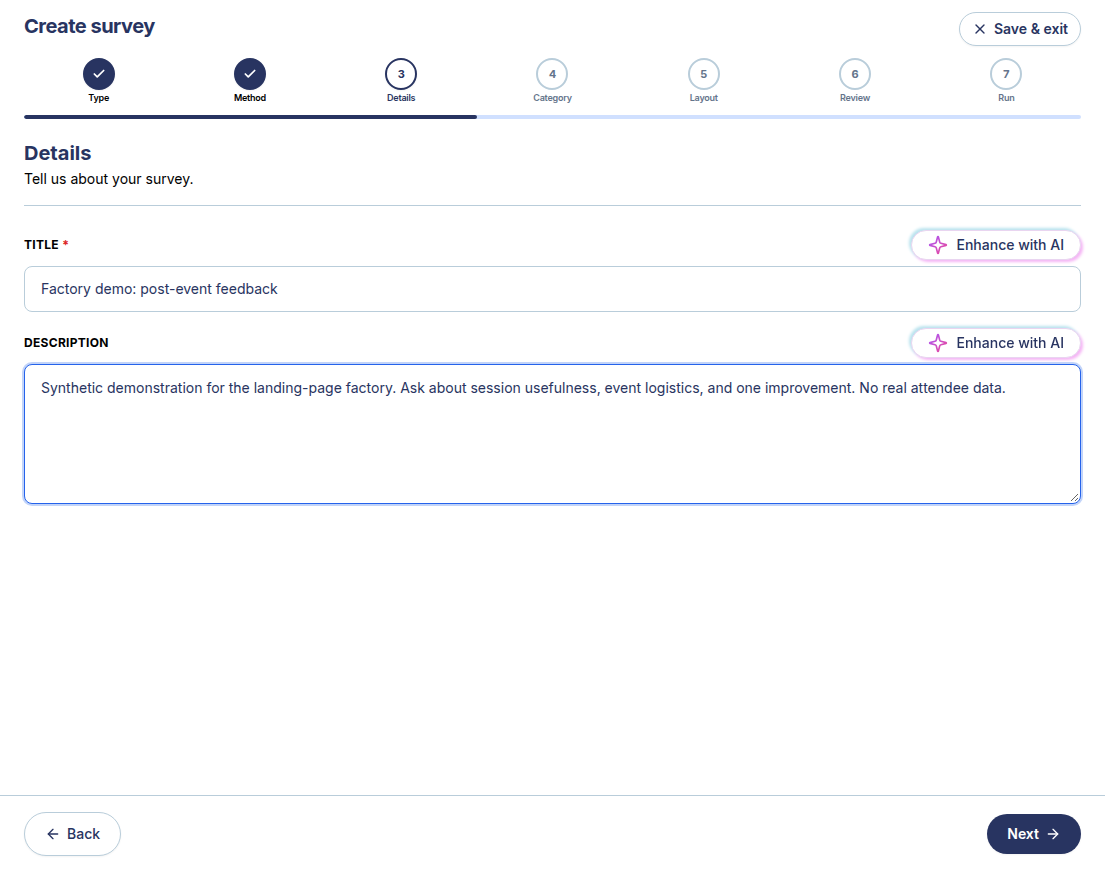
Give the feedback request a clear purpose and explain who will read the answers before you add questions. The actual product screenshot shows a separate synthetic post-event demonstration; the example questions on this page are not already loaded in the product.
Screenshots demonstrate creation and preview. Distribution and results are separate steps; availability varies by account and plan.
Build with SurveyTeams
Use these examples to draft your questionnaire. Create a survey draft, add questions, and check the respondent preview in SurveyTeams. Additional features depend on your account and plan.
Opens product registration. Example questions are not imported automatically.
Learn about the product ↗From question to next step
Write down the decision you want this questionnaire to support: understand how location, communication, and work boundaries affect the team.
Invite people who experienced the relevant situation. Explain response handling and include an optional skip or not-applicable route. Do not infer productivity from home conditions or require personal household details.
Publish a short decision log with owners and dates before adding another recurring call.
Before you send it
Understand how location, communication, and work boundaries affect the team. Start with one decision you can act on rather than using the survey to confirm a preferred answer.
Name a recurring meeting and the information it supplies before assuming an asynchronous update could replace it.
Publish a short decision log with owners and dates before adding another recurring call. This is an example action to investigate, not a guaranteed improvement.
Ask after respondents have experienced the specific situation in the first prompt: “How easy is it to get a decision when working remotely?” Allow enough time after a proposed change for people to experience it before repeating the questionnaire.
After testing the action, revisit this original observation: Example answers describe missed decisions rather than a lack of meetings. Repeat the relevant experience prompts with people who encountered the change. Compare specific explanations and sample differences; do not claim causation from the before-and-after responses.
Copy the questions or download TXT, CSV, JSON, or a Markdown worksheet and adapt them in your own survey. The product CTA opens registration and does not import the example. Verify the features and terms available in your account.
It shows a separate synthetic event-feedback example used to demonstrate the real builder. Copy or download the questions on this page and adapt them in your own draft. Registration does not import them automatically.
Continue exploring