Which information did you need before your first day but could not find?
Locate missing pre-arrival information so the welcome pack can answer practical questions before day one.
People at work · Practical field guide
Find the gaps between accepting an offer and feeling ready to contribute.
Opens product registration. Example questions are not imported automatically.
Try the first three questions here. Nothing is submitted or saved.
A useful starting point
Find the gaps between accepting an offer and feeling ready to contribute. Choose the questions that fit the experience you are investigating; avoid asking people to evaluate a step they did not encounter.
If nothing was unclear or difficult, say so. Skip questions about steps you did not experience; use not applicable where appropriate.
Locate missing pre-arrival information so the welcome pack can answer practical questions before day one.
Separate unclear role expectations from missing system access; they require different owners and remedies.
Ask for one first-week change that a future starter could actually experience, rather than an overall satisfaction score.
Record the delayed permission or account and its timing; do not request passwords, credentials, or confidential access details.
Check whether the escalation route is known, not whether the person is already confident enough to use it.
If nothing was unclear or difficult, say so. Skip questions about steps you did not experience; use not applicable where appropriate.

Which information did you need before your first day but could not find?
How clear are your responsibilities after your first month?
What would make the next new colleague's first week easier?
Which access request took longer than you expected?
Who would you contact if you were unsure about a task?
Download the questions as text ↓
Examples to adapt, rather than a validated research instrument.
A worked interpretation example
Illustrative scenario. These are not customer results.
Several illustrative comments describe waiting for access while the welcome sessions received positive feedback.
Give each access request an owner and review unresolved requests before a new starter's first working day.
After assigning access-request owners, ask whether new starters received the required access before their first task. Compare unresolved requests and specific explanations, keeping role-clarity questions separate.
Choose the response format
| Question | Suggested format | What to preserve |
|---|---|---|
| Which information did you need before your first day but could not find? | Short open text | Locate missing pre-arrival information so the welcome pack can answer practical questions before day one. |
| How clear are your responsibilities after your first month? | Short open text | Separate unclear role expectations from missing system access; they require different owners and remedies. |
| What would make the next new colleague's first week easier? | Short open text | Ask for one first-week change that a future starter could actually experience, rather than an overall satisfaction score. |
| Which access request took longer than you expected? | Short open text | Record the delayed permission or account and its timing; do not request passwords, credentials, or confidential access details. |
| Who would you contact if you were unsure about a task? | Short open text | Check whether the escalation route is known, not whether the person is already confident enough to use it. |
Make questions optional where appropriate. If you add a rating scale, label its endpoints, keep one idea per question, and retain a follow-up for reasons. These examples are not a validated measurement instrument.
Before you send it
Would you agree that employee onboarding feedback was a completely positive experience?
Which information did you need before your first day but could not find?
The initial wording assumes a positive evaluation. The revised question asks about the actual situation so a respondent can describe difficulty, uncertainty, or a different experience.
From question to next step
Write down the decision you want this questionnaire to support: find the gaps between accepting an offer and feeling ready to contribute.
Invite people who experienced the relevant situation. Explain response handling and include an optional skip or not-applicable route. Separate access problems from role clarity; a smooth welcome does not prove readiness.
Give each access request an owner and review unresolved requests before a new starter's first working day.
Read the answers carefully
Separate access problems from role clarity; a smooth welcome does not prove readiness.
Several illustrative comments describe waiting for access while the welcome sessions received positive feedback. This is an illustrative interpretation problem rather than a real customer result. Give each access request an owner and review unresolved requests before a new starter's first working day.
Run a focused feedback cycle
New colleagues after week one; repeat role-clarity prompts at the end of month one.
Separate missing access, missing information and unclear responsibilities. Give access delays to the system owner and role questions to the line manager.
Before the next intake, check that each required account has an owner and a target date. Re-ask the pre-arrival information prompt after the next intake; do not treat a smaller number of comments as a success rate without knowing participation.
Do not collect credentials, medical details or immigration documents. Explain whether managers see individual comments; onboarding surveys are not performance assessments.
Before you send it
Find the gaps between accepting an offer and feeling ready to contribute. Start with one decision you can act on rather than using the survey to confirm a preferred answer.
Separate unclear role expectations from missing system access; they require different owners and remedies.
Give each access request an owner and review unresolved requests before a new starter's first working day. This is an example action to investigate, not a guaranteed improvement.
Ask after respondents have experienced the specific situation in the first prompt: “Which information did you need before your first day but could not find?” Allow enough time after a proposed change for people to experience it before repeating the questionnaire.
After assigning access-request owners, ask whether new starters received the required access before their first task. Compare unresolved requests and specific explanations, keeping role-clarity questions separate.
Copy the questions or download TXT, CSV, JSON, or a Markdown worksheet and adapt them in your own survey. The product CTA opens registration and does not import the example. Verify the features and terms available in your account.
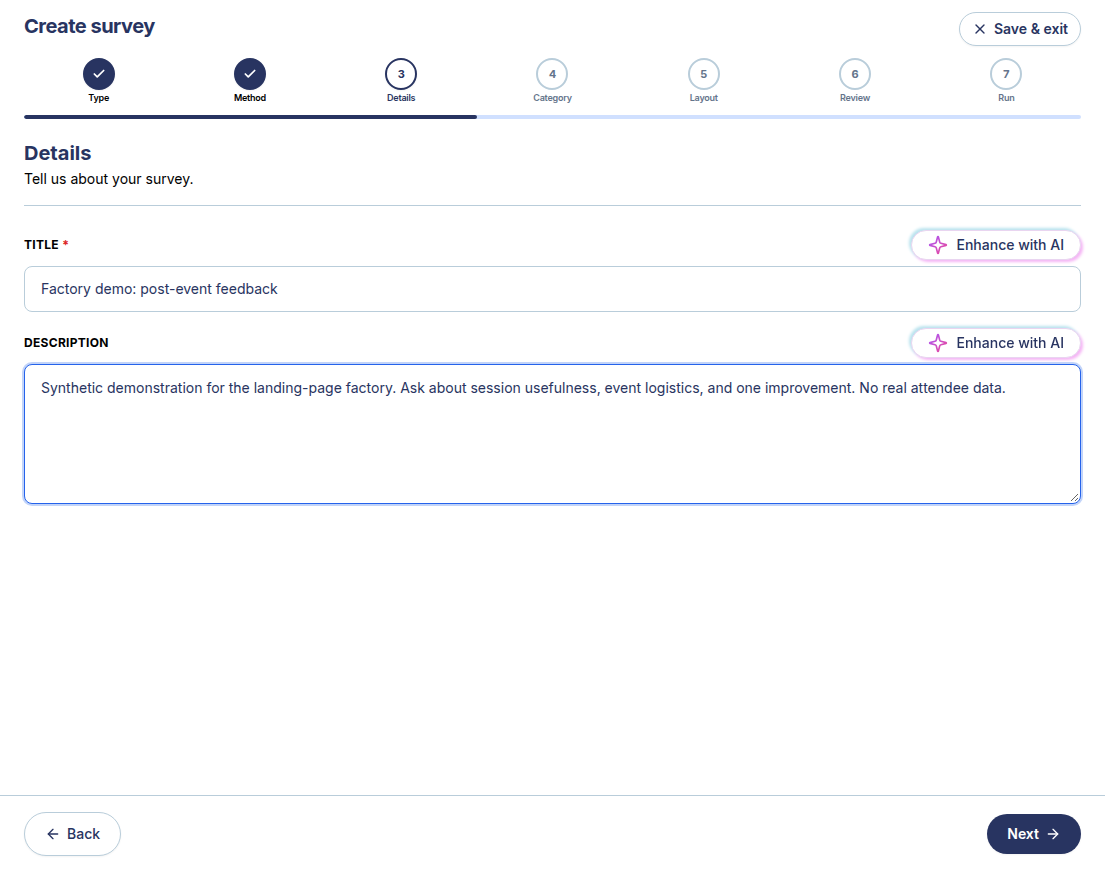
It shows a separate synthetic event-feedback example used to demonstrate the real builder. Copy or download the questions on this page and adapt them in your own draft. Registration does not import them automatically.
Separate missing access, missing information and unclear responsibilities. Give access delays to the system owner and role questions to the line manager.
Do not collect credentials, medical details or immigration documents. Explain whether managers see individual comments; onboarding surveys are not performance assessments.
Inside the product
Give the feedback request a clear purpose and explain who will read the answers before you add questions. The actual product screenshot shows a separate synthetic post-event demonstration; the example questions on this page are not already loaded in the product.
Screenshots demonstrate creation and preview. Distribution and results are separate steps; availability varies by account and plan.
Build with SurveyTeams
Use these examples to draft your questionnaire. Create a survey draft, add questions, and check the respondent preview in SurveyTeams. Additional features depend on your account and plan.
Opens product registration. Example questions are not imported automatically.
Learn about the product ↗Continue exploring